
Updated: Nov. 10, 2025 | Crane games, also known as claw machines or UFO catchers in Japan, are arcade games where you maneuver the claw to try and win a prize, usually either by grabbing it or knocking it off a ledge. A mix of skill and chance, often the thrill of getting the prize beats the prize itself (at least for me).
On this page
To be honest, for the longest time I never really bothered to play these machines, thinking they were rigged and just ate money. But I was proven wrong last summer, when I played one on a whim and actually won a prize! Since then I have been on a mission to master them, and here is what I have garnered so far.
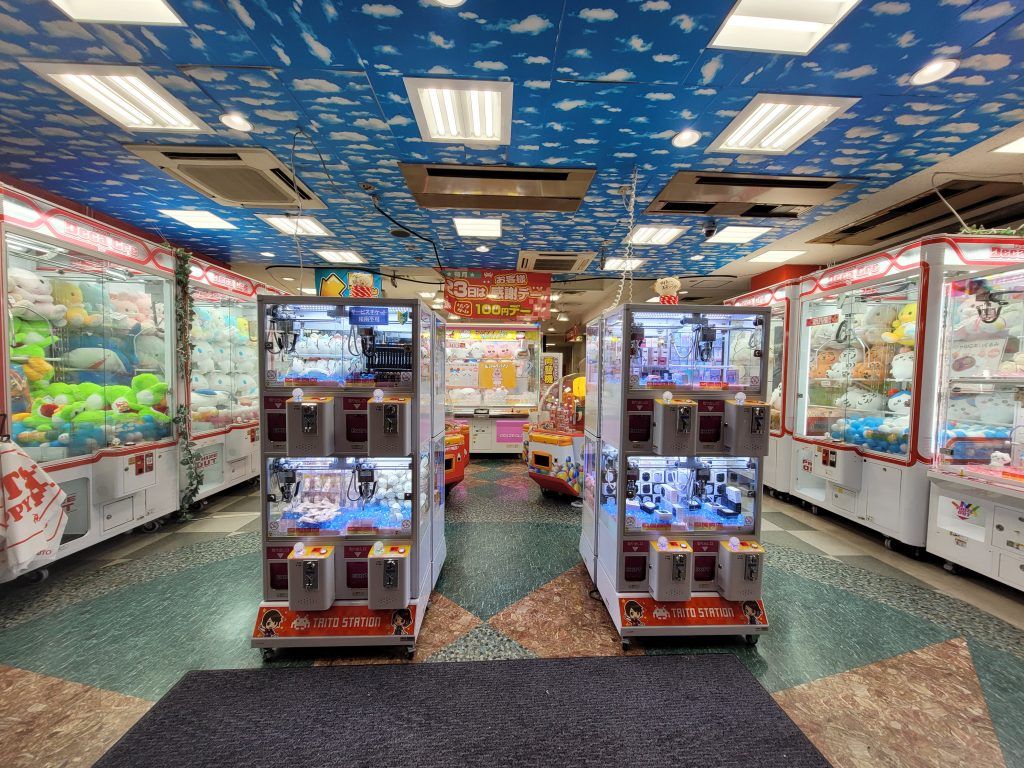
Play crane games remotely for free
To avoid blowing too much money, I recommend first practicing remotely using the Taito Crane app. While nothing beats playing in real life at an arcade, it really helps you get a feel of how the claws move and grip.
The Taito Crane app has practice machines you can play for free, as well as machines you can actually win a prize and they will ship it to you (within Japan). While you need tickets or Taito Coins to play the prize machines, you can get three free play tickets if you install the app through the link below and register your phone number:

Main types of crane games
Three-arm claw
The most fundamental crane game of all, known as 3本爪 in Japanese. You move a three-arm claw to grab the prize and drop it into the opening. There are two main types of claws: The UFO Catcher Triple (shown below) and the Deka-Kure (デカクレ), which is a thinner, twisty type claw. There are also various setups for the “get zone.” Some only have an square opening in the corner, while the smaller (easier) ones can have the entire front section as an opening.

Strategy: The first thing to know about these machines is that are almost all 確率機 [kakuritsu-ki]. This means that the claw is designed to be weak/let go until a certain “payout” value, when it will grip tightly until the opening. Nobody knows what value that is, it could be 20 plays or 60 plays, depending on the arcade and machine.
Since you will likely go bankrupt if you rely on the payout all the time, the key to these machines is either to 1) wedge the claw in a gap or tag or, 2) study how the claw drops the prize, so that you can grip it in such a way that it falls, or moves gradually, toward the opening. The smaller crane machines may be easier than the big ones, as the distance from the claw to the prize is less and therefore easier to estimate. The prize is also much smaller and lighter, improving your chances of getting a good grip.
However, the larger ones often allow you to make use of a “stop” function by pressing the button again while it is descending. This essentially tells to claw to stop its descent and grasp at that point. Many pro crane gamers utilise this function extensively to move the prize as desired or grab its tag.

There are also some variations, where the claw has two pincer-like arms rather than three prongs. These are even simpler to position as there is no twisting, just an open and shut grip. However, their arm power tends to be rather weak, and if the prize is heavy it may fail to move it much.
Hashi-watashi
The aim of 橋渡し [hashi-watashi] machines is to drop the prize through the bars it is resting on. The prize is commonly in the shape of a rectangular box (figurine), a cylinder, or a plushie.

Strategy: The strategy differs slightly depending on the shape of the prize. Like the forward drop, these are not meant to won in one play but over a few movements. If the prize is a figure (rectangular box), the key moves to use are:
- 立てハメ [Tatehame] – the box is sunk vertically, and you pull at the back corners in turn to try and twist it through the bars. The claw should always be off to one side and not in the middle.
- 横ハメ [Yokohame] – same as above but the box is sunk horizontally. This is generally more difficult as a longer edge is resting on the bar.
- 止め掛け [Tomekake] – when box is sunk horizontally with one edge up, you use one arm to hold down the up edge, while the other lifts the edge resting on the bar. This move is only possible if the claw doesn’t open too wide.
- スライド [Slide] – if the box’s top edge/corner is resting on a higher bar, you can get the claw under the bottom edge and slide it up. If successful, it will fall through the bars when it slides back down. If it doesn’t slide back down, use the next technique. Beware of non-slip grips on higher bars.
- ちゃぶ台 [Chabudai] – the box is sitting on a higher bar or ledge, and you flip it through the bars. An alternative is pushing down on the lower edge, although this does not always work if the claw does not descend enough.
- 差し込み [Sashikomi] – a high-level technique where you aim to stab one arm into a box slit to either rotate or lift it.
- Balance Catch (BC) – the box is perfectly balanced on both arms and lifted in the hopes it will drop through the bars, or at least in a favourable position.
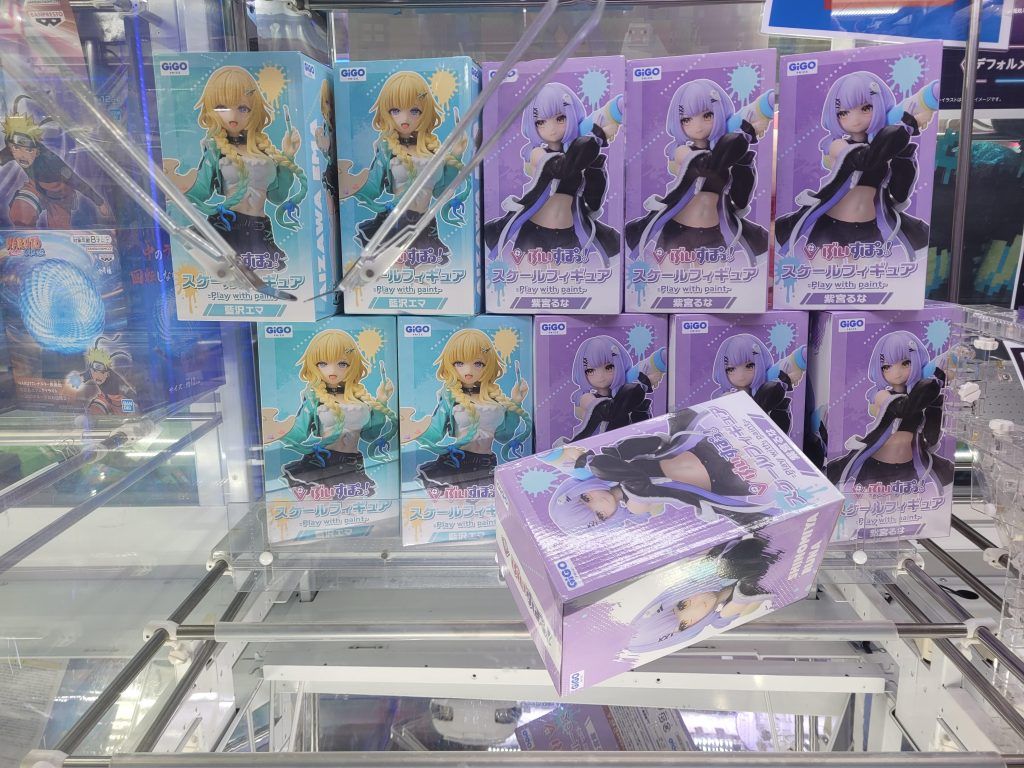
For cylinders, you need to first create an angle, otherwise it will just keep rolling back and forth across the bars. For plushies, the strategy is to grab at it off center to twist it into a position until the centre of mass is through the bars. You can also try to lift the entire thing and hope it drops in a favourable position. The finish almost always involves using the claw to push it down.
A variation of hashi-watashi is 末広り [sue-hirogari], where the bars gradually widen on one end. While this may appear easier, it is not as the prize can only fit through one small section, as opposed to any spot between the bars. Generally avoid playing this setup unless 1) the prize is something soft and squishable like a plushie, or 2) the prize can fit through even before the maximum widening at the end.
Rubber Shovel
A staple of Round 1 arcades and a personal favourite of mine. The claw has “rubber” stops at the end so it grips and lifts the prize. The prize (mostly boxed figurines or snacks) sits on a clear ledge. There are variations at other arcades like Namco and Me Tokyo. But the aim is to drop it off the ledge or through a gap. Check out the video below to see some techniques in action.
Mae-otoshi
In 前落とし [mae-otoshi] machines, the prize is resting at a forward front angle on bars or a ledge, and the aim is to push it off.

Strategy: These are not meant to won in one play, but rather over a few calculated movements. Rather than attempting to lift the prize:
- Position the claw near the front and off to a side to gradually pull it forward, alternating between left and right.
- Keep repeating until the front edge hangs off enough (centre of mass is off the bar).
- Use claw to push down the portion protruding off the front bar, or pull again if force of rebound is enough for it to drop.
Mountain
As the name suggests, prizes are piled up in a mountain and you maneuver a two-arm claw to try and knock them down to the opening in front. Snacks and small plushies are often the prizes in this setup.
Ring

This type of crane game involves using the claw to grab at a ring attached to the prize in order to pull it into the opening. GiGO often features this setup for smaller merchandise like acrylic stands and badges.
Corner balance drop
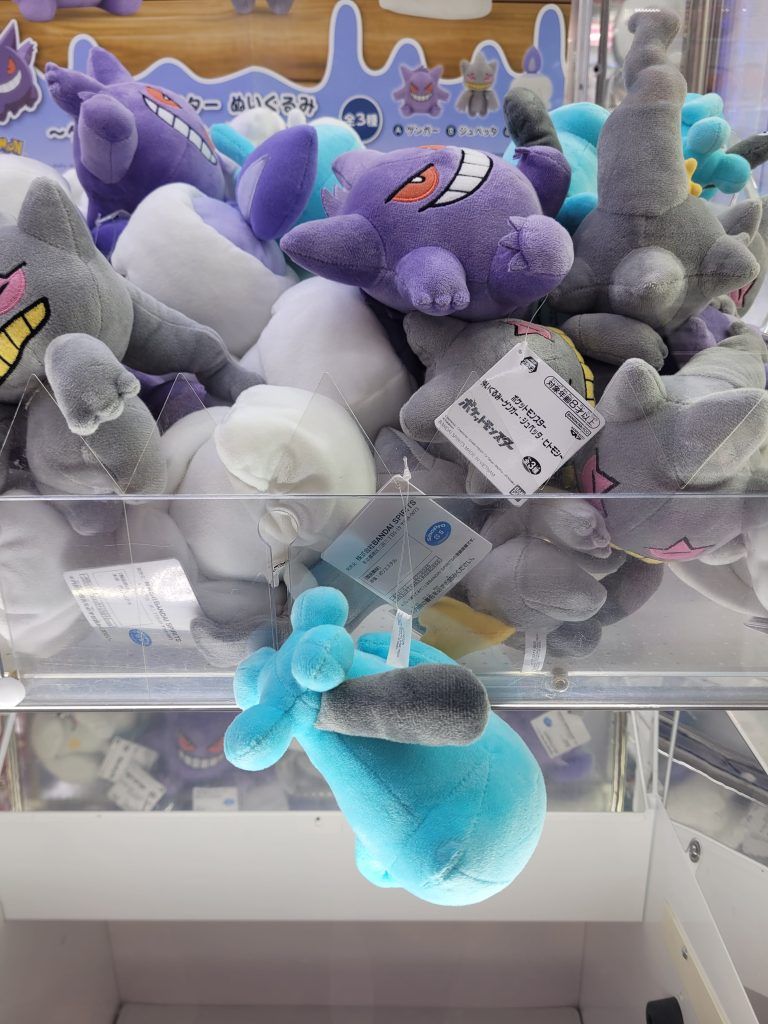
The prize in じかおき [jikaoki] crane games is usually a plushie or soft object resting in the corner of a L-shaped ledge. The aim is to push it over the ledge. Sometimes there is also a bar diagonally across the opening.
Strategy: First, use the claw to the roll the plushie off the platform. You can achieve this by grabbing the skinniest part (or the fattest part the claw can successfully extend around) of the plushie to turn it at angle so it hangs more and more off edge. Once the prize is resting delicately enough on the ledge/bar, use the claw to push it down (and away) from the platform repeatedly until it falls.
Takoyaki balls
In this machine you have a round tray full of ping pong ball sized-holes resembling a takoyaki pan (hence the name), and another bowl full of balls. The crab-shaped claw can only move left and right. You move the claw to the bowl full of balls and attempt to grab as many balls as possible. The claw will then automatically move to the takoyaki pan and drop the balls. If one ball falls into the prize hole (circled in red) then you get the prize.
Strategy: The more balls you can grab, the more chances one will make it into the prize hole. I don’t really like playing this machine type because it seems more akin to playing slots to me, where it is more due to luck rather than any involvement of skill. Maybe there is a way to position to claw to grab more balls, but it seems rather uncontrollable.
Interesting setups

These type of games feature more unusual setups like a ball on chain you use to knock the prize off, or the prize resting on a balloon. Strategy obviously varies depending on setup, but in general hinge on the general principles of centre of mass and gradually shifting into position. More interesting setups include:
- Rubber band (as in the photo above)
- Tower – prizes (usually snacks) are stacked into towers, knock down as many as you can.
- Hook – “One chance” setup. Lower a hook so it catches on a loop below and lifts up a board, causing a shelf with the prizes to fall.
- Ball – Move the ball from the narrow end to the wide end to drop it. The prize is dangling from the ball so will also drop once you get the ball through.
- Hanging – There are few variations to this type of setup. One is a box suspended by two rings on its side with two other rings on the top (four ring box), or a prize dangling from a double ring configuration.
Prizes won
Despite sounding like an avid gamer, I am nowhere near a pro either. I am still learning what works and what doesn’t. If you have better hacks, I’m happy to hear them. But here are some significant prizes won since August 2023, when I started playing casually.
First taste (Aug. 2023)
Ebinyan Mofusand (3 plays) – The first prize I ever won at a UFO catcher was summer 2023, when I got this Ebinyan Mofusand plushie in 3 plays.

I had no real strategy except trying to grip the prize as securely as possible. It was kind of a fluke to be honest. But the thrill of it and dopamine hit from getting a prize set me off on a path to learn how to play these things properly.
A few months later, I got a Kirby in 6 plays in a Namco arcade. My strategy was just to move Kirby to the opening bit by bit since I wasn’t sure how to grip it well. Only thing is that it bounced into the machine below on the way down, so we had to call over a staff to retrieve it for us.
Getting serious (2024)
In January 2024, I got a Luigi pouch + Cinnamoroll in 1 play each after a week of practicing on the Taito Crane app, when I started getting more serious about learning techniques. I am happy to say it paid off!

From then, I started playing every weekend, mostly focusing on small plushies and snacks.
- Foongus (1 play) – somebody had left it in a favourable upside down position to the right of the opening.
- Sumikkogurashi (6 plays) – this one was won in a pincer-type machine
- Namagaki Tsuburana Hitomi Japanese Restaurant (1 play) – This is a vibrating plushie!
- Konezumi (4 plays)
- Chiikawa (3 plays)
- Mini axolotl keychain (9 plays)
- Pompompurin (1 play)
- Wooper Looper axolotl (12 plays)


Enter figurines (Aug. 2024)
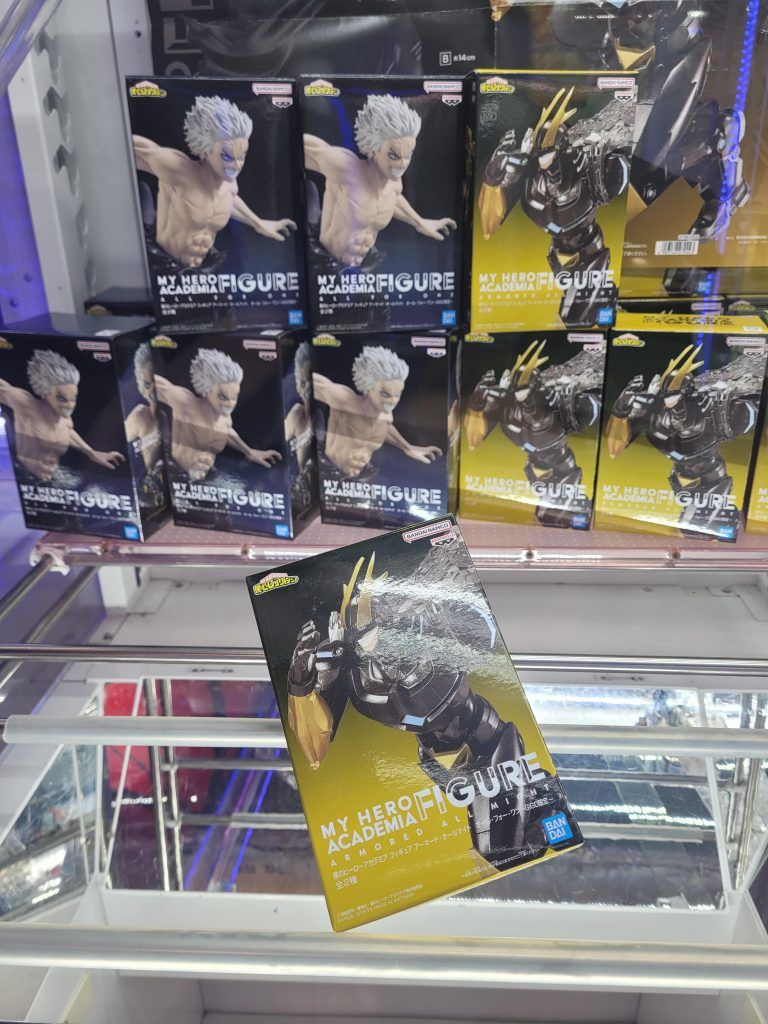
I played for my first figurine in August 2024. Hashi-watashi setup at Round 1, needed assistance as I had no real idea what I was doing. It was a One Piece figurine and I managed to get it in the end, but spent over 3,000 yen on it. After that, I began watching videos by pro crane games to learn the techniques and began gradually getting better.
My best prize haul was in November 2024, when I played at a number of arcades in Shinjuku. In particular, Me Tokyo was having a campaign where they had a few machines on ridiculously easy settings. I spent around 15,000 yen overall but snagged about 20 prizes, ranging from plushies, figurines and snacks. Here’s a YouTube Short I made of the day.
Becoming more selective (2025)
In my second year of crane gaming, I have a better idea of what arcades to play at, and what prizes to aim for. At the same time, machine settings are constantly changing, so what worked before sometimes suddenly no longer does. Arcades really like to keep gamers on their toes.
Summary: General tips

- If you are a beginner, you should first trying playing at the small claw machines or for snacks. Some arcades even have labels showing which ones are easy to get.
- For the big claw machines, you can ask staff to reposition the prize to its start position before playing. If you are adamant about getting the prize, you can also get the staff to put it in an easy-to-get position after you’ve spent a certain amount of money.
- Most crane games are not meant to won in one play. So you could save some money by buying a set of plays. For example, some arcades offer 6 plays for 500 yen, essentially giving you a free play. You can also save money by scouring the machines and seeing which prizes other people may have already moved into a favourable position before they gave up.
- Using the claw to push down and/or gradually position the prize is more often the key than lifting it up randomly and hoping for the best. Although the latter can also work at times, if you are lucky enough to get the payout.
- Some games are not worth it; the claw is too weak or the prize is cheap. Know when to walk away. Also, almost every prize can be found resold on Mercari if you really want it.
- For big plushies or popular figurines that are likely to be gone quickly, play for them online the moment they are released (usually midnight or 10am.)

Not into crane games? Check out other gaming-related articles to see fun ways to spend time in Tokyo.
11 thoughts on “The Beginner’s Guide to Mastering Crane Games”
This guide is super helpful for someone who’s always been intrigued by crane games but never knew where to start! I love the tips on strategy and how to choose the right machines. Can’t wait to try out some of these techniques on my next arcade visit! Thanks for sharing!
Thanks for your kind comment! Glad you found my rough guide useful. If it’s a bit difficult to visualise, feel free to check out videos of plays on my Youtube channel too! https://www.youtube.com/@unborderedlife
Comments are closed.